French occupation of Moscow
War and PeaceFrench occupation of Moscow is the decisive reversal of the 1812 campaign: the French enter the Russian capital after a military victory, yet possession of the city does not produce the submission of Russia. Instead, occupation dissolves the very army that achieved it. Moscow becomes an emptied, combustible space where imperial authority, military discipline, property, and the ordinary distinction between soldier and civilian lose their stability.## Causes and Political Setting The occupation arises from the immense movement of armies that began in 1811 and culminated on June 12, 1812, when the forces of Western Europe crossed the Russian frontier. The narrative rejects the idea that such a catastrophe can be reduced to a diplomatic error or to the intention of a single ruler. Historians attribute the war to the wrongs inflicted on the Duke of Oldenburg, the Continental System, Napoleon Bonaparte’s ambition, Emperor Alexander I’s firmness, or the mistakes of diplomats; each explanation captures only the limited perspective of one participant. The occupation of Moscow therefore belongs to a wider process in which millions of people, not merely sovereigns, generals, and ministers, are drawn into violence on a scale that overwhelms individual explanations.
The evacuation of Moscow is represented as inevitable after the Battle of Borodino and as part of a broader Russian response already visible in towns and villages beginning with Smolensk. Wealthier inhabitants leave while abandoning houses and property, whereas poorer people remain and destroy what cannot be carried away. This movement is not presented as the result of Count Fyodor Rostopchin’s broadsheets alone. Its force comes from a collective, almost instinctive patriotism that acts unobtrusively rather than through theatrical declarations. By the time the French arrive, the city has therefore been deprived of the civilian population and of the social arrangements that ordinarily make occupation governable.
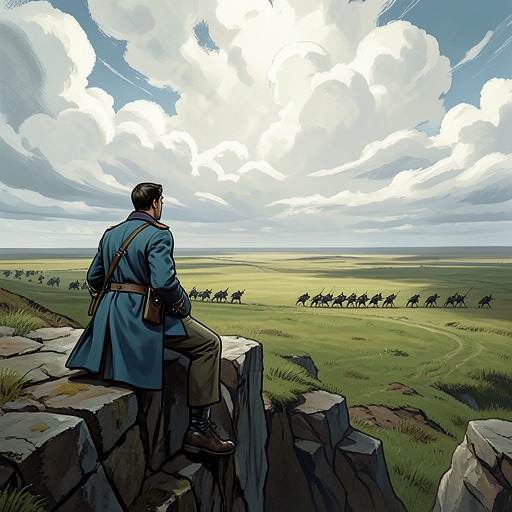
The withdrawal of the Russian army intensifies the disorder. On the night of September 1, Mikhail Kutuzov orders a retreat through Moscow toward the Ryazan road. During the following morning, troops crowd the Dorogomilov Bridge and the surrounding streets, while the rear guard remains in the suburb. At ten o’clock on September 2, the Russian army is already on the far side of the city or beyond it, while Napoleon stands on Poklonnaya Hill looking over Moscow. The contrast is stark: Russian forces are passing through and away from the capital, while the French commander observes a city that appears intact but has already been emptied of the population needed to sustain ordinary urban life.## Entry into the Empty Capital Toward four o’clock in the afternoon, Murat’s troops enter Moscow. A detachment of Württemberg hussars rides first, followed by Joachim Murat, King of Naples, with a large suite. Near the Church of the Miraculous Icon of St. Nicholas on the Arbat, Murat pauses while awaiting news about the condition of the Kremlin. The few people who remain stare at the unusually dressed commander, whose feathers and gold make him appear almost unreal to them. An interpreter tells the crowd to remove their caps, imposing a small ceremonial gesture of submission before an audience that is timid, bewildered, and uncertain what the new power represents.
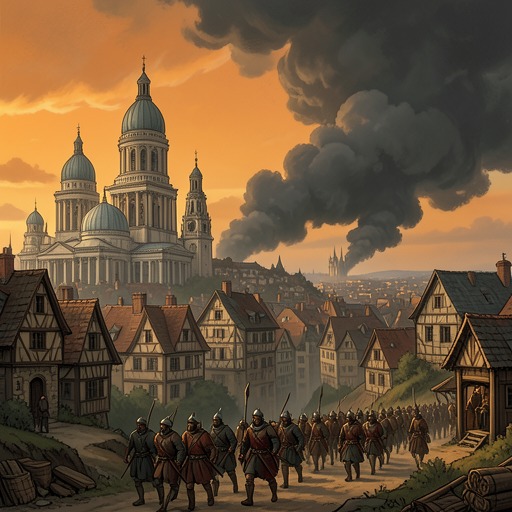
The French enter the Kremlin after the way has been cleared. Soldiers pitch their camp in Senate Square and throw chairs from the Senate House windows to use as fuel. Other detachments occupy streets including Moroseyka, Lubyanka, Pokrovka, Vozdvizhenka, Nikolski, and Tverskoy. Because no masters are present, the French are not billeted among inhabitants according to the usual arrangements. They live in the city as in a camp. Although tattered, hungry, exhausted, and reduced to roughly a third of their original number, they enter in good marching order and remain, for the moment, a fighting and menacing army.
That military form lasts only until the soldiers disperse among the wealthy and deserted houses. The occupation thus changes the status of the invaders from an army to something neither civilian nor military: marauders. Their purpose changes with it. They no longer act primarily to conquer Moscow; they seek to retain whatever they have acquired. The narrative’s image of the monkey that grips nuts inside a narrow-necked jug captures the trap: the soldiers’ possessions burden them, yet abandoning the loot becomes psychologically impossible. The apparent triumph of conquest contains the condition of later ruin.
The city’s abundance accelerates this transformation. Soldiers discover provisions in cellars and storerooms, unlock or break into coach houses and stables, and rush through the streets in search of valuables. Cavalrymen who find sufficient stabling in one abandoned merchant’s house continue to the next because another appears better. Some claim several houses, mark them with their names, and quarrel or fight with other companies over possession. In Carriage Row, generals select abandoned caleches and coaches for themselves. The few inhabitants who remain invite commanding officers into their homes in the hope of protecting themselves from plunder, but this attempt to convert rank into shelter only reveals how thoroughly ordinary authority has failed.
The process is described as an engulfing. The French spread from the Kremlin through the wealthy city like water percolating through sand, while the city and the army disappear into one another. The material plenty of Moscow seems limitless, but it cannot restore the army’s cohesion. The entry of a famished force into a rich and deserted capital produces fires, looting, and the destruction of both the army and the city that has received it.## Fire, Responsibility, and the Failure of Control The Fire of Moscow cannot be assigned simply to one person or one national character. The French attribute it to the ferocious patriotism of Count Fyodor Rostopchin; the Russians attribute it to French barbarity. The narrative rejects both explanations as insufficient. A wooden city left without inhabitants, occupied by soldiers who smoke, cook, and kindle fires, is placed in conditions where burning becomes almost unavoidable. Moscow burns not because a single will commands every flame, but because the material and social circumstances of occupation make conflagration the likely result.
The details of occupation make the argument concrete. In peacetime, houses with owners, police, and ordinary urban supervision already experience frequent fires. In an abandoned city, those restraints disappear. Soldiers use the Senate chairs as fuel, light campfires, and prepare meals twice a day. The destruction is therefore an effect of occupation’s routine practices as much as of deliberate hostility. The city does not merely suffer an external attack; it becomes the combustible environment in which the invading army’s everyday needs consume the object it has conquered.
The same collapse of responsibility appears in the treatment of Vereshchagin. Rostopchin presents the young chained man to a crowd and declares him the traitor who has caused Moscow to perish, accusing him of betraying his Tsar and country by going over to Bonaparte. When Rostopchin hands him over to the crowd, the crowd initially remains silent, pressing inward under the pressure of fear, curiosity, and expectation. The scene shows authority attempting to manufacture a public explanation for a disaster too large and complex to be embodied by one prisoner. The city’s catastrophe is translated into a single guilty body.
The occupation also exposes the limits of official plans. Napoleon Bonaparte’s campaign plans, praised by historians as works of genius, cannot be executed because they are disconnected from the facts. Fortifying the Kremlin proves useless; mining it contributes only to its later destruction. Diplomatic efforts fail because Emperor Alexander I does not receive or answer the envoys. Administrative measures do not stop robbery, and the municipality becomes useful chiefly to those who loot or protect their own property under the pretext of preserving order. The mechanisms of command continue to issue instructions, but they no longer engage the circumstances they are supposed to govern.## Captivity and the Occupation’s Legal Order The occupation creates a precarious legal world in which people are classified, detained, interrogated, and killed according to procedures that claim rational authority while concealing their desired outcome. Pierre Bezukhov is arrested and taken to a guardhouse. His captors treat him with hostility but also with respect because they are uncertain whether he is an important person. The next guard, however, sees only a stout man in a peasant coat and identifies him as No. 17 among captured Russians. His individuality has been replaced by a number.
Pierre’s French speech makes him conspicuous, while his status as a gentleman separates him from the other prisoners. He is confined with men of the lowest class, who avoid him partly because he speaks French. The prisoners are eventually informed that they may be tried for incendiarism. At the interrogation, a French general with a white mustache and several officers ask the prescribed questions about identity, location, and purpose. The questioning appears precise, but its structure is designed to lead answers toward conviction rather than to discover the essence of what happened. The legal form remains visible even as its relation to justice disappears.
The logic reaches its most terrible expression when the prisoners are led to a post and a freshly dug pit. Pierre is sixth in the prescribed order. Germans, Italians, and Frenchmen watch, while French troops stand in lines on either side. The beating of drums tears away his ability to think or understand, reducing the execution to a mechanism of bodies, commands, and sound. Later, when a corporal closes the shed door despite the illness and groans of a prisoner, Pierre recognizes in the corporal’s altered face and in the drums the same impersonal force that compels people to kill against their will. The occupation is therefore not only a military presence in Moscow; it is a system that reorganizes human beings into captors, prisoners, officials, instruments, and disposable lives.## Consequences and Historical Significance The occupation’s central paradox is that the French win Moscow and lose the campaign. After the French victory at Borodino and the entry into Moscow, there is no subsequent general engagement capable of explaining the destruction of the French army by conventional battle alone. The narrative insists that Moscow is taken, yet it is not Russia that ceases to exist. Instead, the six-hundred-thousand-strong French army and then Napoleonic France itself begin to disappear. Military victory fails to produce conquest because conquest requires more than control of a battlefield or a capital; it requires food, transport, order, cooperation, and a population willing to sustain the occupying force.
The refusal of the countryside to provide forage makes this failure material. The peasants Karp and Vlas, who do not embody heroic feelings in any theatrical sense, nevertheless refuse to bring hay to Moscow even when offered a high price. They burn it rather than supply the French. This ordinary act, repeated by an innumerable multitude, denies the occupation the logistical foundation on which an army depends. The force that determines the fate of peoples therefore lies neither simply in commanders nor in battles, but in the dispersed decisions of soldiers, peasants, townspeople, and other groups whose actions cannot be reduced to a single plan.
The occupation also prepares the conditions for the Russian partisan war of 1812. Scattered groups attack concentrated forces, withdraw from stronger opponents, and strike again when opportunity appears. Such warfare violates the conventional tactical rule that an attacker should concentrate forces at the decisive moment, yet it becomes effective because the conflict has taken on a national character. The occupation turns the distinction between battlefield and society into a porous one: resistance emerges not only from formal armies but from the population’s refusal to provide shelter, food, transport, or passive cooperation.
French occupation of Moscow thus functions as a state of apparent power and actual disintegration. It begins with the ceremonial entry of Murat and the sight of Moscow spread beneath Napoleon Bonaparte on Poklonnaya Hill; it proceeds through the empty houses, stolen goods, improvised fires, executions, interrogations, and failed administrative remedies; and it culminates in the transformation of an army into a marauding mob. The city’s burning is both a physical catastrophe and a structural revelation. Once occupation has severed the ties among military command, urban inhabitants, property, and supply, the conqueror’s presence becomes self-consuming, and the capital that seemed to crown the invasion becomes the place where its failure is made visible.